

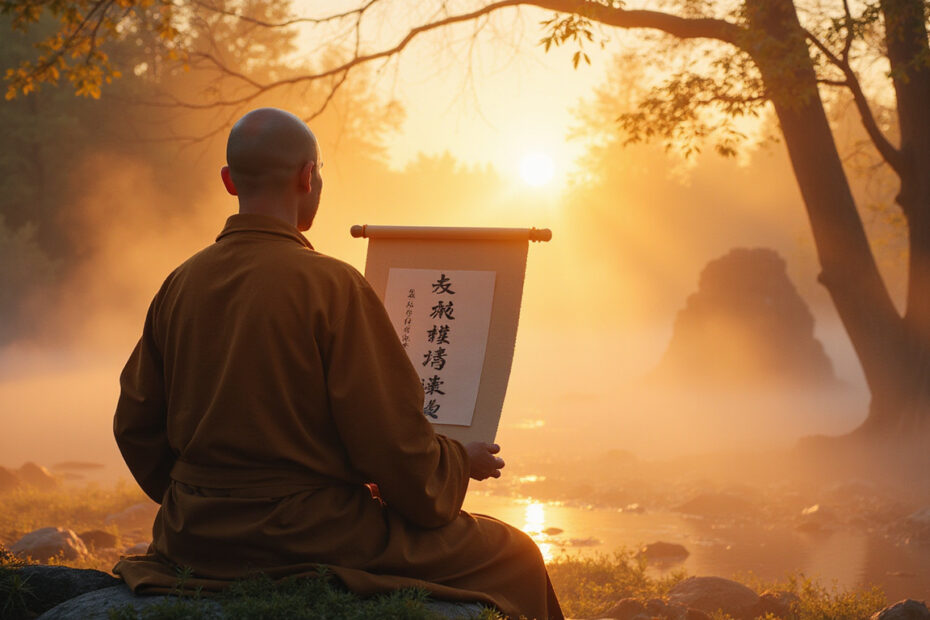
Koan practice is often imagined as something mysterious that only advanced Zen monks in mountain monasteries can do. In reality, koans can become a simple, powerful part of daily life, helping you see through habits, loosen rigid thinking, and awaken deeper awareness right where you are—at home, at work, or standing in line at the grocery store.
This guide will show you what koan practice really is, how it works, and how to integrate it into your day with clear, accessible methods, even if you’ve never meditated before.
What Is Koan Practice, Really?
In the Zen tradition, a koan is a short, often puzzling saying, story, or question used to shift your usual way of thinking. Classic examples include:
- “What is your original face before your parents were born?”
- “What was your face before you were born?”
- A master simply raising a finger or shouting “Katz!”
Koan practice is the art of sitting with these questions or moments in a way that bypasses analytical thought. Instead of “solving” a koan like a riddle, you let it work on you—so that your perception changes.
Key points to understand:
- A koan is not a puzzle with a logical answer.
- It aims to interrupt your normal, concept-driven mind.
- It points you back to direct experience in the present moment.
- It can be practiced formally (in meditation) and informally (throughout your day).
Why Koans Are Powerful for Awareness
Koan practice is uniquely suited for modern life because it directly targets the patterns that keep us stuck: overthinking, self-criticism, reactivity, and constant distraction.
1. Koans Short-Circuit Overthinking
Your usual thinking patterns want clear, linear answers. A good koan refuses to cooperate with that demand, gently forcing you to rest in “not knowing.” This can be uncomfortable at first—but that’s exactly why it’s transformative.
Over time, this “not knowing” becomes spacious and peaceful. You discover that awareness is present even when the mind has no conclusions.
2. Koans Reveal Your Default Stories
When you sit with a koan, you quickly see how you interpret everything through personal stories:
- “I’m bad at this.”
- “This doesn’t make sense.”
- “I need to get this right.”
These reactions are part of the koan’s teaching. They show you where you cling, defend, or shut down. Noticing them is already a step toward freedom.
3. Koans Bring You Back to Direct Experience
Instead of thinking about life, koan practice brings you back to living it—breathing, seeing, hearing, feeling. The koan becomes a doorway into the present moment, where awareness is already clear and complete.
As Zen teacher Joan Sutherland says, koans are “conversations with reality,” not abstract philosophy (source: Lion’s Roar).
Getting Started: A Simple Approach to Koan Practice
You don’t need years of training or a special retreat to begin. Start where you are, with a simple structure.
Step 1: Choose a Koan That Resonates
For beginners, it helps to choose a short, evocative koan that feels alive or intriguing rather than intimidating. Here are a few options:
- “What is this?”
- “Who is hearing?”
- “Just this.”
- “What is it?”
- “Who am I?” (used in some Zen and nondual traditions)
Pick one and stay with it for at least a few weeks. Consistency matters more than variety.
Step 2: Set a Modest Daily Time
Begin with:
- 5–10 minutes per day, once or twice daily
You can sit cross-legged, on a chair, or even lie down if needed (though sitting upright helps alertness). The main point is relaxed, stable posture.
Step 3: Invite the Koan, Then Listen
Here’s a simple method:
- Settle into your posture and take a few slow breaths.
- Silently bring the koan to mind:
- For example, “What is this?”
- Let the words echo once or twice inside.
- Then rest in silence.
- When your mind wanders, gently return to the koan—not forcing, just touching it like a bell.
Instead of repeating the koan rapidly like a mantra, let it sink in like a question you ask with your whole being, not just the head.
Step 4: Let the Question Open, Not Close
You are not trying to answer the koan with an idea.
When thoughts like “The answer is awareness” or “The answer is emptiness” appear, notice them and let them pass. Those may be interesting concepts, but the koan is pointing to something you directly experience rather than think about.
Stay with the open-endedness:
- What is this…sound?
- What is this…breath?
- What is this…feeling in my chest?
Allow curiosity to be genuine and soft.
Integrating Koan Practice into Daily Life
Formal sitting is only half of koan practice. The other half is bringing the koan into everyday moments, where you can test insight and release old habits in real time.
Here are practical ways to weave it into your day.
1. Use Transitions as Koan Moments
Choose ordinary transitions as “bells of mindfulness” to recall your koan:
- When you open a door: silently ask, “What is this?” and feel the moment.
- While washing your hands: “Who is feeling this water?”
- Before answering your phone or a message: pause, touch the koan, then respond.
This turns daily life into a living temple, where everything becomes part of your practice.
2. Turn Emotional Reactions into Koan Doors
Koan practice is especially powerful when you’re triggered or upset.
Example:
- Someone criticizes you. Anger or shame arises.
- Instead of immediately defending, pause for a breath.
- Ask, “What is this?”—not to suppress the feeling, but to look directly at it.
- Notice the sensations: tight chest, flushed face, rapid thinking.
- Stay with the lived experience, not the story about it.
Over time, this softens reactivity. Emotions still appear, but they become waves in a wider awareness rather than absolute truths.
3. Walk with the Koan
Walking meditation with a koan can be grounding:
- As your foot touches the ground, silently ask, “What is this?”
- With the next step, rest in not knowing.
- Let sounds, sights, and bodily sensations all be included.
This is a great way to practice if sitting still feels difficult. The body’s movement keeps you engaged while the koan works quietly in the background.
A Simple Daily Koan Practice Routine
Here’s a basic structure you can experiment with for 2–4 weeks:
-
Morning (5–10 minutes)
- Sit comfortably.
- Bring your chosen koan to mind once or twice.
- Rest in silence, returning to the koan whenever you drift.
-
During the Day
- Choose 3–5 triggers (doorways, phone notifications, meal times).
- Each time, pause for one breath and silently recall the koan.
- Let that breath be fully conscious.
-
Evening (5–10 minutes)
- Sit again with the koan.
- Briefly reflect: How did the koan show up today? Did it change how you reacted?
Consistency is more valuable than intensity. A little every day is better than a lot once a week.
Common Obstacles in Koan Practice (and How to Work with Them)
As you deepen koan practice, you’ll likely meet familiar challenges. These are part of the teaching, not signs of failure.
“I Don’t Get It”
You’re not supposed to “get it” in a conventional sense. Koans are designed to defeat your usual way of understanding. When you feel confused, that’s the edge where old habits loosen.
What to do:
- Acknowledge: “Confusion is here.”
- Let the confusion itself be the “this” in “What is this?”
- Stay with the immediate experience of not knowing.
“I’m Doing It Wrong”
Self-judgment is another classic visitor. It often shows up as thoughts like:
- “Real Zen practitioners would be doing better.”
- “I’m not spiritual enough for this.”
What to do:
- Notice these thoughts as mental events, not facts.
- Ask, “What is this feeling of ‘wrongness’?” Feel it in the body.
- Include the judgment in your practice rather than arguing with it.
“Nothing Is Happening”
Results in koan practice are often subtle and gradual. You might expect fireworks; instead, you may see small shifts:
- Slightly more space around thoughts.
- A bit less reactivity in conversation.
- Moments of simple, unadorned presence.
What to do:
- Trust the process of showing up each day.
- Look for practical changes in your life, not mystical experiences.
- Remember: awareness is already here; koan practice reveals it rather than creating it.
How Koan Practice Differs from Mindfulness Meditation
Both mindfulness and koan practice support awareness, but they do so in different ways.
-
Mindfulness often emphasizes:
- Observing thoughts, feelings, and sensations non-judgmentally.
- Returning to an anchor like the breath.
- Cultivating calm and clarity.
-
Koan practice emphasizes:
- Entering a living question or story that cuts through habitual thinking.
- Letting go of fixed reference points, including the sense of a separate “meditator.”
- Opening to sudden or gradual shifts in how reality is perceived.
Many people combine both: using mindfulness to stabilize attention and koan practice to challenge deeper assumptions about self and world.
Benefits You May Notice Over Time
With steady koan practice, people often report:
-
Greater mental flexibility
Less stuckness in rigid opinions and self-descriptions. -
Reduced reactivity
A bit more space before reacting, especially in emotionally loaded situations. -
Increased presence
More moments of simply being here without needing to improve or analyze the moment. -
Subtler sense of self
The “me” at the center of experience feels less solid; awareness feels more spacious and shared.
None of these need to be forced. They tend to emerge naturally as you keep returning to the living question at the heart of your koan.
FAQ: Koan Practice and Related Questions
1. How do I know if I’m ready for Zen koan practice?
You’re ready for Zen koan practice if you have:
- A basic willingness to sit quietly, even for 5 minutes.
- Curiosity about deeper awareness.
- Openness to not having clear, immediate answers.
Prior meditation experience helps but isn’t required. Just start gently and don’t push for dramatic outcomes.
2. Can I do koan meditation without a teacher?
Yes, you can do simple koan meditation on your own, especially with foundational koans like “What is this?” or “Who is hearing?” A teacher becomes more important if you engage in advanced, traditional koan curricula (e.g., hundreds of classic cases in Rinzai Zen).
If possible, reading contemporary Zen teachers, joining online talks, or occasionally visiting a local Zen center can offer valuable guidance.
3. What is the best koan for daily spiritual practice?
There is no single “best” koan, but for daily spiritual practice, short, open-ended koans are excellent:
- “What is this?”
- “Who is hearing?”
- “Just this.”
Choose one that feels alive to you. The “best” koan is the one you’re willing to stay with through boredom, confusion, and daily life.
Bringing It All Together: A Daily Invitation to Wake Up
Koan practice is not about becoming a different person or mastering a mysterious Zen technique. It’s about gently, persistently turning toward the truth of your own experience—again and again—until your usual stories soften and a wider, clearer awareness shines through.
You don’t need special conditions to begin. You can start today:
- Pick a simple koan like “What is this?”
- Sit with it for 5–10 minutes.
- Let it accompany you through doorways, conversations, and emotional storms.
If you feel drawn to deepen this exploration, consider finding a local or online Zen group, reading contemporary koan teachers, or setting up a small daily ritual devoted to your practice.
Your life itself is the great koan. Every moment is an invitation to wake up. Begin now, exactly where you are, and let koan practice quietly transform the way you see, feel, and live.