

Guided Imagery Exercises That Melt Stress and Improve Sleep
If your mind won’t switch off at night or stress follows you from work to bed, guided imagery is one of the simplest, most effective tools you can add to your routine. You don’t need special equipment, a meditation cushion, or hours of free time. You just need your imagination and a few minutes of focused practice to help your body and brain power down.
Below you’ll learn how guided imagery works, why it’s so soothing for stress and insomnia, and several step‑by‑step exercises you can start using today.
What Is Guided Imagery?
Guided imagery is a relaxation technique where you use your imagination to create calming, positive images, sensations, and scenarios in your mind. Think of it as “intentional daydreaming” with a purpose.
You can:
- Listen to an audio recording that talks you through a scenario, or
- Guide yourself using a script or mental outline
Unlike some forms of meditation that focus on clearing the mind, guided imagery gives your mind something gentle and structured to focus on—like walking along a peaceful beach, floating on a cloud, or resting in a cozy cabin during a snowfall.
Why Guided Imagery Works
Guided imagery is powerful because your brain responds to imagined experiences much like real ones:
- Your breathing and heart rate slow down
- Muscle tension decreases
- Stress hormones such as cortisol can drop
- The relaxation response is activated, preparing your body for rest
Studies suggest that guided imagery can reduce anxiety, improve sleep quality, and help with pain management when used regularly (source: National Center for Complementary and Integrative Health).
How Guided Imagery Reduces Stress
Stress often shows up as racing thoughts, tight muscles, and shallow breathing. Guided imagery addresses each of these at once.
It Redirects Runaway Thoughts
When you’re stressed, your mind tends to loop through the same worries. Guided imagery gently redirects that mental energy into a different, more peaceful “story.” By filling your attention with specific sights, sounds, and sensations, there’s simply less mental space for rumination.
It Calms the Nervous System
Imagining a safe, soothing environment signals to your nervous system that you’re not in danger right now. Over time, this repeated “practice of safety” can make you more resilient to daily stressors.
You may notice:
- Shoulders and jaw unclenching
- Easier, slower breathing
- A feeling of warmth or heaviness in arms and legs
- A subtle mental “distance” from your problems
How Guided Imagery Improves Sleep
Sleep struggles often involve:
- Trouble falling asleep (mind won’t stop)
- Waking frequently during the night
- Waking too early and not being able to drift back off
Guided imagery helps in several ways:
- Pre-sleep ritual – Doing the same relaxing practice each night trains your brain: “These cues mean it’s time to sleep.”
- Less mental noise – By focusing on a calming scene, you crowd out to-do lists, worries, and internal chatter.
- Body relaxation – Many guided imagery exercises incorporate breath and body awareness, which helps shift you into a drowsy state.
Used consistently, it can become as familiar and comforting as a favorite bedtime story, but designed specifically to trigger sleep.
Getting Started: Simple Setup for Guided Imagery
You don’t need to overcomplicate things. Start with these basics:
- Choose your position: Lie on your back in bed for sleep, or sit in a supportive chair for daytime stress relief.
- Minimize distractions: Silence notifications; dim lights. Earbuds or headphones can help if you’re using an audio track.
- Decide on your format:
- Listen to a recording (many free options exist in apps and online), or
- Read through a script a couple of times and then guide yourself from memory.
- Start short: 5–10 minutes is enough in the beginning. You can build up to 20+ minutes as it feels comfortable.
Guided Imagery Exercise #1: The Safe Place Visualization
This core guided imagery practice is ideal for melting stress any time of day and can double as a pre-sleep routine.
Step-by-step:
-
Settle and breathe
- Close your eyes.
- Take 3 slow, deep breaths: in through the nose, out through the mouth.
- Let your breath return to a natural, comfortable rhythm.
-
Choose your safe place
- Picture a location where you feel completely safe and at ease.
- It could be real (a favorite beach, cabin, park) or imagined (a mountaintop, floating island, quiet library).
-
Engage all five senses
Take your time with each sense:- Sight: Colors, shapes, light, shadows. What do you see around you?
- Sound: Waves, leaves, a crackling fire, distant birds, soft music.
- Smell: Ocean air, pine trees, fresh rain, coffee, or baked bread.
- Touch: The ground under your feet, the temperature on your skin, a blanket wrapped around you.
- Taste (optional): A warm drink, cool water, or simply the clean taste of the air.
-
Add a sense of safety
- Tell yourself silently: “In this place, I am safe. Nothing can disturb me here.”
- Feel your body responding—a little heavier, more grounded.
-
Stay and explore
- Walk around your safe place in your mind.
- Notice small details: texture of the ground, movement of the air, play of light.
- If worries intrude, acknowledge them briefly and then return to the next detail you can see, hear, or feel.
-
Return gently (for daytime use)
- When you’re ready, deepen your breath.
- Wiggle fingers and toes.
- Open your eyes, bringing some of that calm back with you.
For sleep, you can simply let the scene fade naturally as you drift off; there’s no need for a formal “ending.”

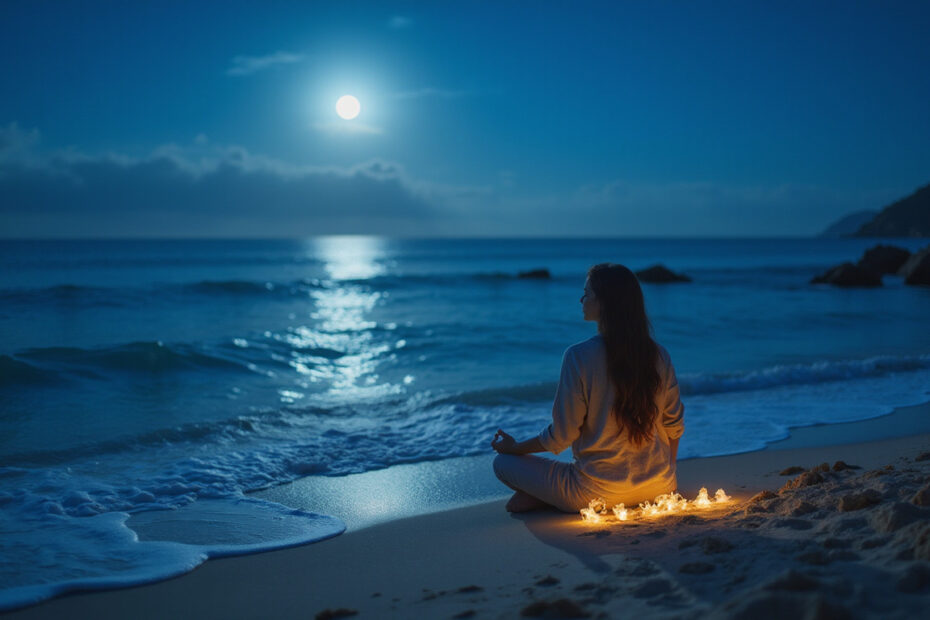
Guided Imagery Exercise #2: Beach Walk for Better Sleep
This is a classic guided imagery script designed especially for bedtime. Read it a few times, then practice from memory, or record yourself reading it slowly and play it back.
Beach imagery script:
- Lie comfortably on your back, arms at your sides, eyes closed.
- Take a slow breath in… and a long, soft breath out. Repeat three times.
- Imagine you are standing on a quiet beach at sunset. The sky is painted with soft pinks and golds.
- Feel the sand beneath your bare feet—warm, slightly firm, but yielding softly as you shift your weight.
- Hear the rhythmic sound of gentle waves rolling in, one after another, steady and predictable.
- With each wave that comes to shore, feel a little more tension leaving your body.
- A light breeze brushes your skin, just cool enough to be refreshing.
- You begin to walk slowly along the water’s edge. With every step, your body grows heavier and more relaxed.
- Notice the faint scent of salt in the air, clean and calming.
- Far in the distance, you may hear a seagull or see a small boat, but everything feels peaceful, unhurried.
- As you walk, your eyelids grow heavier. Your mind is content to focus only on the sound of the waves… and the feeling of the sand… and the softness of the fading light.
- You find a comfortable place to sit or lie down on the beach. The sand molds to support you perfectly.
- The last light of day slowly melts into twilight. You feel safe, warm, and deeply tired in the best possible way.
- Each breath becomes slower… deeper… easier… as you sink into the quiet of this safe, beautiful place.
Let yourself continue this scene or simply rest in the sensations until sleep arrives.
Guided Imagery Exercise #3: Body Scan with Healing Light
This exercise combines guided imagery with a body scan, perfect for unwinding physical tension after a long day.
How to practice:
-
Get comfortable
Lie down or recline, close your eyes, and take a few slow breaths. -
Imagine a gentle light
- Visualize a soft, warm light above the crown of your head.
- Choose a color that feels healing or calming to you—gold, soft white, pale blue, or lavender.
-
Move the light through your body
- As the light slowly moves from one area of your body to the next, imagine it bringing warmth, ease, and relaxation.
- Move in order:
- Top of head and scalp
- Forehead, eyes, cheeks, jaw
- Neck and shoulders
- Arms, forearms, hands, fingers
- Chest and upper back
- Stomach and mid-back
- Hips, thighs, knees
- Calves, ankles, feet, toes
-
Release tension with each exhale
- At each body part, pause for one or two breaths.
- Inhale: imagine the light gently filling that area.
- Exhale: imagine any tightness or stress melting away, draining into the ground.
-
Rest in full-body relaxation
- When the light has reached your feet, visualize your entire body bathed in this soothing glow.
- Stay with that image for several breaths, feeling fully supported and at ease.
This form of guided imagery not only calms the mind but helps you reconnect with your body, which is especially useful if stress tends to “live” in your shoulders, neck, or back.
Tips to Make Guided Imagery More Effective
To get the most from your guided imagery practice:
- Practice at the same times daily – For example, mid-afternoon to manage stress, and again at night for sleep.
- Be patient with wandering thoughts – Minds wander; that’s normal. When you notice it, gently return to the scene’s details.
- Personalize your scenes – Use places, seasons, and details that genuinely soothe you (forest vs. beach, cozy room vs. open sky).
- Layer in physical comfort – Soft blankets, comfortable clothing, and a cool, dark room enhance the effect at bedtime.
- Combine with breathwork – Slow, 4–6 second exhales pair beautifully with guided imagery for deeper relaxation.
Consistency matters more than perfection. Even 5 minutes daily can gradually retrain your body to relax more quickly.
Common Mistakes to Avoid
A few small tweaks can make guided imagery far more enjoyable:
- Trying too hard to “see” everything clearly
- Many people experience imagery more as a sense or impression than a vivid movie. That’s perfectly fine.
- Judging your performance
- There’s no “right way.” If you end up more relaxed than when you started, it’s working.
- Only using it in crisis
- It’s most powerful when it becomes a regular habit, not just an emergency tool on restless nights.
Quick-Start Checklist for Your First Week
Use this simple plan to build momentum:
- Day 1–2: 5 minutes of the Safe Place exercise during the day
- Day 3–4: 5–10 minutes of the Beach Walk at bedtime
- Day 5–7: Add the Healing Light body scan on evenings when your body feels tense
Notice any changes in:
- How quickly you unwind at night
- How often you wake during the night
- Your general stress levels during the day
Write a few notes in the morning; patterns will emerge surprisingly fast.
FAQ: Guided Imagery, Relaxation, and Sleep
1. Is guided imagery meditation, and how is it different from other relaxation techniques?
Guided imagery is considered a type of meditation, but instead of focusing on the breath or a mantra alone, you focus on detailed mental images and sensations. Compared to methods like progressive muscle relaxation or simple deep breathing, guided imagery engages more of your senses and imagination, which some people find makes it easier to stay focused and relax.
2. How often should I use guided imagery for sleep problems?
For insomnia or frequent nighttime waking, use guided imagery every night for at least 2–4 weeks before judging results. Treat it like a new sleep habit: the more consistently you practice, the faster your brain will associate your chosen imagery with winding down and falling asleep.
3. Can guided imagery for anxiety be used during the day too?
Yes. Guided imagery for anxiety and stress works very well in short “mini-sessions” during the day—before a big meeting, on a lunch break, or after a stressful commute. Even 3–5 minutes of a safe place or healing light visualization can reset your nervous system and prevent stress from building up, which in turn supports better sleep at night.
Guided imagery gives you a portable, always-available way to step out of stress and into a calmer, sleep-ready state—without needing anything but your imagination. You can start today, in just a few minutes, and refine your favorite scenes over time until they become as familiar and comforting as a well-worn bedtime story.
Begin tonight: choose one of the exercises above, dim the lights, and let your mind walk the beach, rest in your safe place, or bathe in healing light. With regular practice, you’ll train both body and mind to melt stress more quickly and slip into deeper, more restorative sleep—night after night.