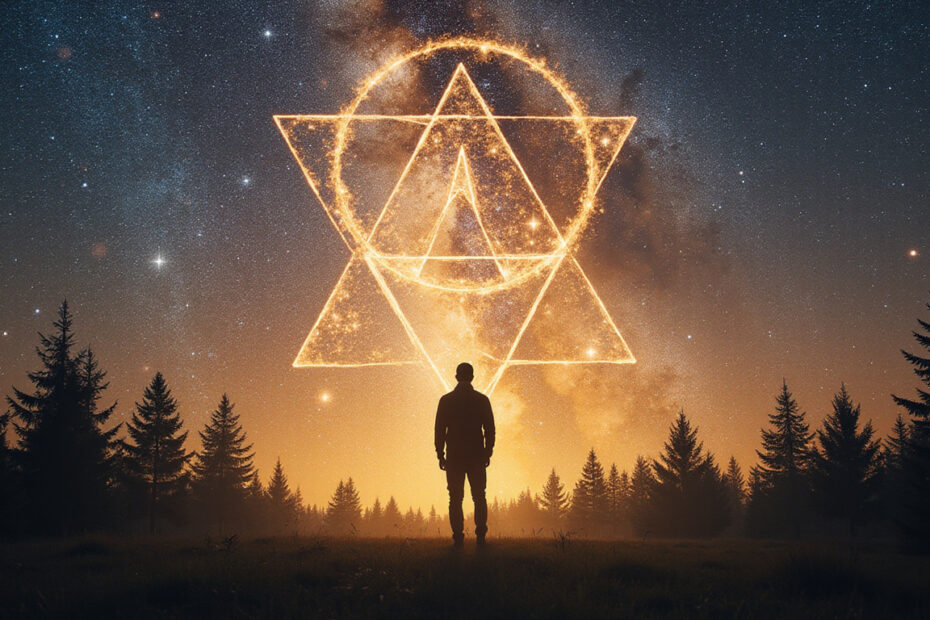
Pantheism is the view that the divine is not separate from the universe, but identical with it: God is everything, and everything is God. Instead of imagining a distant deity in a far-off heaven, pantheism experiences the sacred in stars and soil, in breath and body, in every moment of existence. This shift from “God out there” to “God right here” can profoundly change how you see yourself, other people, and the world you live in.
Below, we’ll explore what pantheism is, its roots, how it affects daily life, and why seeing the divine in everything can be personally and spiritually transformative.
What Is Pantheism?
Pantheism comes from two Greek words: pan (all) and theos (god). Put simply, it is the belief that the universe and the divine are one and the same. Instead of a supernatural being outside of nature, the divine is nature, the cosmos, and all reality.
There are many shades of pantheism, but most share a few core ideas:
- Immanence: The divine is present in everything—every atom, every lifeform, every galaxy.
- Unity: All things are interconnected expressions of one underlying reality.
- Reverence for nature: The natural world is not “just matter” but sacred and worthy of care and awe.
Pantheism doesn’t always require belief in a personal God who intervenes in events. For some, “God” is a poetic way of talking about the totality of existence. For others, it is the living presence that permeates every aspect of the cosmos.
A Brief History of Pantheistic Thought
Though the term “pantheism” is relatively modern (coined in the 18th century), the intuition behind it is ancient and cross-cultural.
Ancient and Eastern Roots
Elements of pantheistic thinking appear in:
- Hinduism: The idea of Brahman as the ultimate reality pervading all things has strong pantheistic strands.
- Stoicism: Ancient Stoic philosophers saw the universe as a living, rational whole, infused with the divine Logos.
- Taoism: The Tao is the underlying principle of the universe, present in all things and beyond all categories.
- Indigenous traditions: Many Indigenous spiritualities experience land, animals, and elements as alive and sacred, not separate from spirit.
Western Philosophy and Spinoza
In the West, pantheism is often associated with Baruch Spinoza (17th century), who wrote that God and Nature are two names for the same reality. For Spinoza, everything that exists is a part of God, and understanding this can lead to deep peace and freedom.
Later thinkers like Goethe, Einstein, and some Romantic poets expressed pantheistic sensibilities, seeing the universe as a majestic, intelligible whole worthy of spiritual reverence (source: Stanford Encyclopedia of Philosophy).
Core Ideas: What Pantheism Actually Says About Reality
To understand how pantheism can transform you, it helps to unpack a few of its central claims.
1. The Universe Is Sacred
If everything is an expression of the divine, then:
- Trees and rivers are not just “resources” but holy.
- Your own body is not an obstacle to spirit, but a manifestation of it.
- Everyday life—commuting, cooking, working—unfolds within the sacred.
This doesn’t mean denying science. Many modern pantheists embrace cosmology, evolution, and physics, seeing them as ways of appreciating the divine complexity of reality.
2. Separation Is an Illusion
Pantheism emphasizes the deep interconnectedness of all things. You are not a completely independent being; you are a node in an immense web of relationships—biological, ecological, social, cosmic.
When you internalize this, it becomes harder to see others as “them” and yourself as entirely separate. Compassion and responsibility naturally expand.
3. The Divine Is Here and Now
Instead of postponing meaning to an afterlife or distant spiritual realm, pantheism locates sacredness in the present moment:
- In the rhythm of your breath.
- In the warmth of sunlight.
- In the flow of conversation and silence.
Spiritual life becomes less about escaping the world and more about awakening to its depth.
How Pantheism Can Transform Your Inner Life
Shifting to a pantheistic perspective doesn’t just change abstract beliefs; it can deeply affect how you feel and live.
A Deeper Sense of Belonging
Many people struggle with a feeling of existential isolation—being a stranger in a vast, indifferent universe. Pantheism offers a different story: you are not a random accident in a meaningless cosmos; you are a conscious expression of the very reality that gives rise to stars and galaxies.
This can foster:
- Rootedness: Feeling at home on Earth, not alienated from nature.
- Identity expansion: Seeing yourself not just as an isolated individual but as the universe becoming aware of itself through you.
Reduced Fear of Death
Pantheism tends to soften the sharp edges around mortality. If everything is a continuous expression of one reality, then:
- Your individual form changes and dissolves, but the underlying “stuff” you are made of remains part of the whole.
- Death becomes transformation, not annihilation.
This doesn’t remove grief or fear entirely, but it can infuse them with a peaceful acceptance: what you really are—the universe expressing itself—does not cease.
Greater Presence and Mindfulness
Pantheism naturally encourages mindful awareness. If the divine is in everything, then every moment can be approached with reverence:
- Washing dishes becomes an intimate contact with water, heat, texture.
- Walking in the city becomes a study in intricate patterns of life.
- Listening to someone becomes an encounter with another facet of the same divine reality.
This mindset supports many meditative and contemplative practices, whether or not you follow a specific religious path.
Ethical Implications: How Pantheism Shapes Your Actions
Seeing the universe as sacred is not just a comforting idea; it carries concrete ethical implications.
Care for the Earth
If nature is a manifestation of the divine, then harming ecosystems is not just “bad for the environment”—it is desecration. Pantheism can motivate:
- Environmental activism
- Conservation efforts
- Simpler, lower-impact lifestyles
You don’t protect nature only because you depend on it; you protect it because it is holy in itself.
Compassion for All Beings
Pantheism widens the circle of moral concern. Other people, animals, and even ecosystems are not “objects out there”; they are other expressions of the same reality that lives in you.
This can encourage:
- Non-violence and empathy
- Opposition to cruelty and exploitation
- Respect for cultural and spiritual diversity
Humility and Responsibility
If everything is the divine, then you are both incredibly significant and profoundly humble. You are not the center of the universe, yet you are an essential thread in its vast tapestry.
That balance can foster:
- Responsibility without arrogance
- Confidence without egotism
- Service without self-erasure
Practicing Pantheism in Daily Life
You don’t need to adopt a label to explore pantheistic ways of seeing. You can experiment with practices that cultivate a sense of unity and sacredness in ordinary life.

1. Nature Immersion
Regularly spend time in nature—even a city park or your own backyard. While there:
- Observe details: leaves, insects, patterns of wind and light.
- Notice your senses: smell, touch, sound, temperature.
- Silently acknowledge: “This is not separate from me; I am part of this.”
Over time, this can shift “nature” from a scenic background to a living, sacred community.
2. Daily Reverence Ritual
Create a simple ritual to honor the divine in everything. For example:
- In the morning: Light a candle or open a window and take three slow breaths, recognizing the air as a gift of the living Earth.
- Before meals: Pause for a moment of thanks—not just to a deity, but to sun, soil, water, farmers, and all beings involved in your food.
- At night: Reflect on one moment of the day when you felt connected to something larger than yourself.
The point is not perfection, but consistency—a gentle daily reminder of unity.
3. Seeing the Divine in Others
Try a short experiment:
- In a conversation, silently remind yourself, “This person is another expression of the same reality as me.”
- Notice whether this softens judgment, increases patience, or deepens listening.
Pantheism, practiced this way, becomes a relational spirituality, not just a cosmic idea.
4. Integrating Science and Wonder
Read or watch content about astronomy, biology, or ecology—and let it feed your sense of the sacred:
- The story of the Big Bang and stellar evolution as a sacred origin story.
- The complexity of a single cell as an object of reverence.
- The interdependence of ecosystems as a living web of divinity.
Pantheism can transform scientific knowledge into spiritual insight: the more you understand the universe, the deeper your awe.
Addressing Common Misunderstandings
Because pantheism is different from more familiar theistic models, it’s often misunderstood.
“Is pantheism just nature-worship?”
Pantheism does honor nature, but not in a superficial way. It isn’t just about appreciating pretty landscapes. It sees all of reality—ugly and beautiful, simple and complex—as expressions of the same divine whole. This includes human culture, technology, and even struggle and decay.
“Does pantheism deny personal experience of God?”
Not necessarily. Many pantheists report deep mystical or devotional experiences. The difference is that they interpret these experiences not as encounters with a separate, external deity, but as awakenings to the divine aspect of reality itself.
“Is pantheism compatible with my current beliefs?”
For some, pantheism becomes a new spiritual home. For others, it blends with existing paths:
- Some Christians, Hindus, Buddhists, and others interpret their traditions in pantheistic or panentheistic ways.
- Some atheists or agnostics resonate with pantheism as a poetic, reverent way of expressing their love of the natural world, without believing in a supernatural god.
Pantheism can be a framework, a lens, or a full spiritual identity—how you relate to it is personal.
FAQ About Pantheism and Related Ideas
Q1: What is pantheism in simple terms?
Pantheism is the belief that God and the universe are the same thing. Instead of a separate creator, the divine is identical with all of existence—every star, every person, every particle is part of God.
Q2: How is pantheistic spirituality different from traditional religion?
Pantheistic spirituality usually focuses less on dogma and more on direct experience of unity and sacredness in the natural world. It often emphasizes science, ecology, and personal exploration over fixed creeds or institutional authority.
Q3: What’s the difference between pantheism and panentheism?
Pantheism says the divine and the universe are identical. Panentheism says the divine includes the universe but also transcends it: everything is in God, but God is more than everything. The two views are closely related and sometimes overlap in practice.
Let Pantheism Change How You See Everything
Pantheism invites you to live as if the sacred is not elsewhere but everywhere—through the rustle of leaves, the hum of traffic, the rise and fall of your own breath. It suggests that you are not a stranger in the universe but its conscious expression, inseparable from the stars that forged your atoms and the soil that feeds your body.
If this way of seeing resonates with you, don’t leave it as a theory. Begin experimenting:
- Spend a little more time in nature with intentional presence.
- Practice small daily moments of reverence.
- Approach others as fellow expressions of the same underlying reality.
As you do, notice whether your sense of isolation softens, your compassion grows, and your life feels more deeply rooted in meaning. Pantheism isn’t just a belief—it’s a way of inhabiting the world that can quietly, steadily, transform you.